

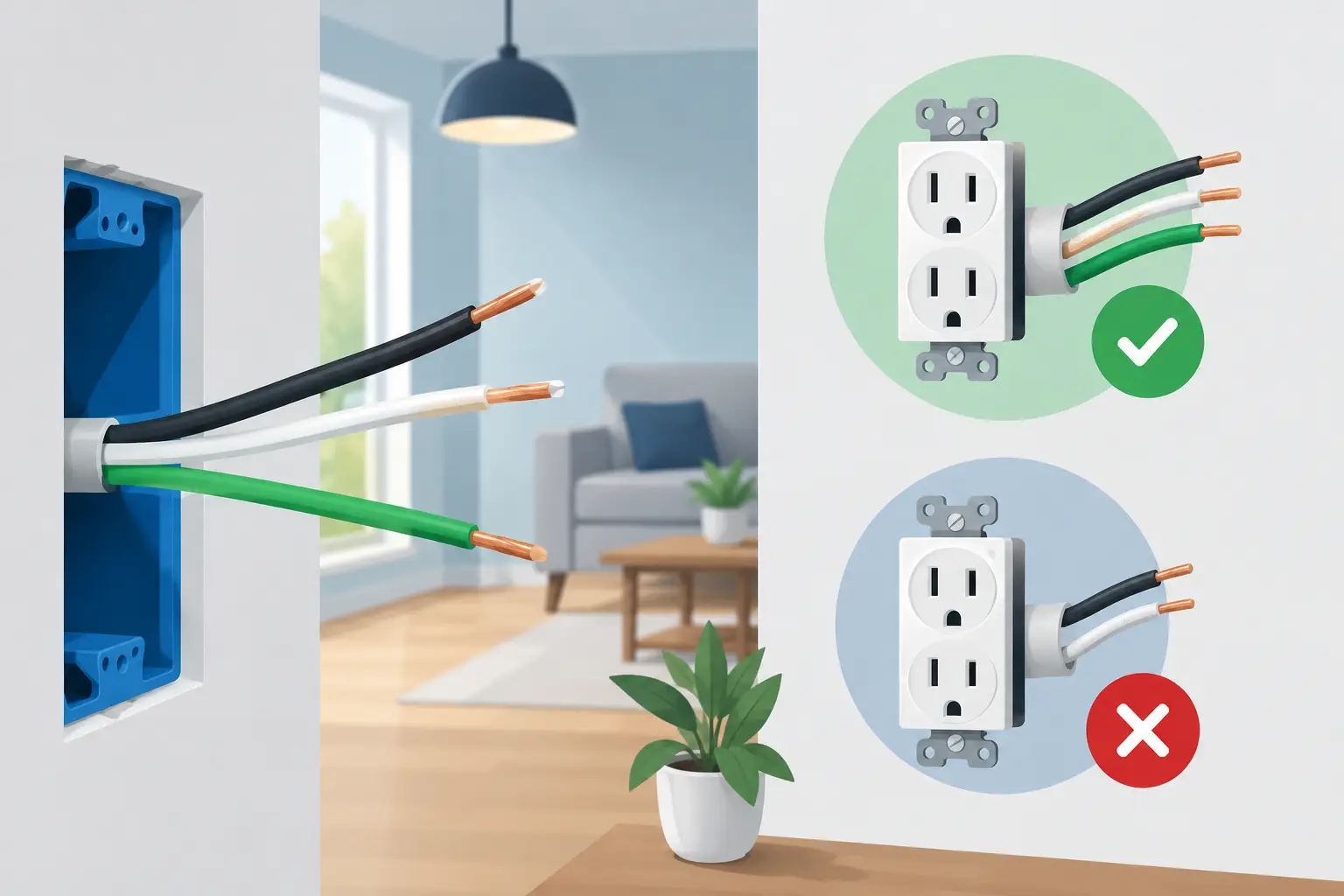
A whole-home rewire is the moment when hidden electrical problems finally become visible. If you are opening walls to replace aging wiring, the question is not just, “Do all circuits need a ground wire in a rewire?” It is also whether the finished system will safely support the way your family uses power now – from kitchen appliances and home offices to EV chargers, smart devices, and modern electronics.
For most rewiring projects, the practical answer is yes: new branch-circuit wiring should include an effective equipment grounding path. In a typical home, that means a grounding wire runs with the circuit conductors and connects outlets, fixtures, appliances, and metal electrical boxes back to the electrical panel. There are a few important exceptions and wiring-method details, which is why a licensed electrician should evaluate the home before work begins.
Why Grounding Matters During a Rewire
The ground wire is a safety path. Under normal operation, it does not carry electricity the way a hot wire or neutral does. Its job is to give unwanted fault current a low-resistance path back to the source if a hot wire touches the metal case of an appliance, a metal box, or another conductive part that should not be energized.
That path helps the breaker trip quickly. Without it, a metal appliance housing or electrical box could remain energized until someone touches it and provides a path to ground. Grounding does not prevent every electrical hazard, but it is a fundamental layer of protection against shock and fire risks.
Grounding is particularly valuable in homes with sensitive electronics. Computers, TVs, smart-home hubs, appliances with circuit boards, and EV charging equipment all benefit from a properly designed electrical system. A grounded system also works alongside other modern protections, including GFCI outlets, AFCI protection where required, and whole-home surge protection.
Do All Circuits Need a Ground Wire in a Rewire?
When existing wiring is being fully replaced, modern code requirements generally call for an equipment grounding conductor or another approved grounding path for the new circuit. For most residential rewires, electricians accomplish this by installing modern NM cable, often called Romex, that includes a bare or green grounding wire alongside the hot and neutral conductors.
That does not always mean every circuit needs a separate bare copper wire in the exact same form. Certain approved metal raceways and conduit systems can serve as the equipment grounding path when installed correctly and kept electrically continuous. The key is not simply seeing a green or bare wire. The key is having an effective, code-compliant fault-current path.
A few specialized circuits may also have different conductor arrangements. A 240-volt appliance circuit, for example, may not need a neutral if the equipment does not use 120-volt components. It will still typically need equipment grounding for exposed metal parts and connected equipment. The conductor requirements depend on the load, the equipment instructions, the wiring method, and local code enforcement.
For a homeowner planning a rewire, the simple standard is this: do not treat grounding as optional on newly installed wiring. A qualified electrician should identify the appropriate grounding method for every circuit and verify that it is properly bonded at the panel and connected at every device location.
Ground Wire, Neutral Wire, and Grounding Electrode: Not the Same Thing
These terms are easy to mix up, especially in older homes where wiring may not match modern expectations.
The neutral wire carries current back to the electrical source during normal operation on many 120-volt circuits. The equipment grounding conductor is there primarily for fault conditions and bonding metal parts. They have different jobs, even though they are connected together at the service equipment under specific conditions.
The grounding electrode system is another part of the picture. This is the connection between the electrical service and the home’s grounding electrodes, which may include ground rods, a concrete-encased electrode, or other approved electrodes. It helps stabilize the electrical system’s reference to earth and supports safety during certain abnormal conditions. It is not a substitute for a properly grounded branch circuit.
In other words, adding ground rods does not make ungrounded outlets throughout a house safe. Each circuit and device still needs an appropriate equipment grounding path.
What If Your Home Has Two-Wire, Ungrounded Circuits?
Many older Baltimore-area homes and Mid-Atlantic properties still have two-wire cable with a hot and neutral but no equipment ground. Some may have old cloth-insulated wiring, knob-and-tube wiring, ungrounded three-prong outlets, or a mix of wiring added during different renovations.
Existing ungrounded circuits are not automatically illegal simply because they are old. Whether they can remain in place depends on their condition, the scope of the renovation, local requirements, and how the circuits are being altered. But a full rewire is different from a minor repair. Once you are replacing branch-circuit wiring, it makes sense to bring that work up to current safety standards rather than recreating an outdated system behind fresh drywall.
Sometimes homeowners ask whether an electrician can simply install three-prong receptacles on old two-wire circuits. That can create a false sense of security if the receptacle ground is not actually connected. In limited situations, code may allow GFCI protection for an ungrounded replacement receptacle when it is labeled correctly. However, GFCI protection does not create an equipment ground, and it does not provide the same protection or functionality as a properly grounded circuit.
A GFCI can help protect people from dangerous leakage current. It cannot make surge protectors, electronics, and metal equipment behave as though a real equipment grounding conductor is present.
A Rewire Is Also a Chance to Correct Circuit Design
Grounding is essential, but it is only one part of a good rewire. Homes built decades ago were not designed around air fryers, multiple bathroom appliances, home-office equipment, large TVs, induction ranges, EV chargers, and connected devices in nearly every room.
During the planning stage, an electrician should look at how the home is used, not just replace old wires one for one. That may mean adding dedicated circuits for the refrigerator, microwave, dishwasher, disposal, laundry equipment, sump pump, HVAC equipment, or a future EV charger. Kitchens, bathrooms, garages, outdoor areas, and unfinished spaces have specific protection needs that should be addressed as part of the design.
Panel capacity matters, too. A rewire may reveal that the existing panel is crowded, outdated, damaged, or too small for planned upgrades. If you want to add central air, a hot tub, an electric range, a heat pump, solar equipment, or Level 2 EV charging, it is better to evaluate the panel and service early rather than discover limits after walls are already open.
Common Grounding Problems Found in Older Homes
Electrical inspections often uncover improvised fixes that look acceptable at first glance but do not provide a safe grounding path. An electrician may find grounded outlets connected to no ground at all, loose or corroded grounding connections, bootleg grounds that improperly tie neutral to ground at a receptacle, or metal boxes that were never bonded.
Other homes have grounded cable but damaged connections at boxes, fixtures, or the panel. A ground wire that is cut short, disconnected, or poorly spliced cannot do its job when a fault occurs. Continuity testing and careful inspection matter because grounding problems are not always visible from the front of an outlet.
Older wiring can also have insulation damage, overloaded circuits, loose terminations, or hidden junction boxes. Rewiring gives homeowners the opportunity to correct these issues in a planned way instead of waiting for flickering lights, nuisance breaker trips, warm outlets, or an emergency failure.
How to Plan a Safer Rewire
Start with a full electrical assessment. A professional should inspect the panel, service equipment, visible wiring, outlet grounding, major appliances, and any signs of prior alterations. Share your renovation plans and future electrical needs, even if those projects are a few years away.
Ask how the electrician will handle grounding, GFCI and AFCI protection, panel capacity, permits, and inspection requirements. You should also receive a clear scope of work that explains which circuits will be replaced, where new outlets or dedicated circuits will go, and what wall access or repairs may be required.
Stella Electric can help homeowners evaluate aging wiring, build a practical rewire plan, and complete upgrades with safety and daily convenience in mind. Clear pricing and professional troubleshooting make it easier to make decisions before a small wiring concern turns into a larger repair.
If your home has ungrounded outlets, aging wiring, or a renovation on the calendar, treat the rewire as an investment in how safely and comfortably your home will work for years to come.








