

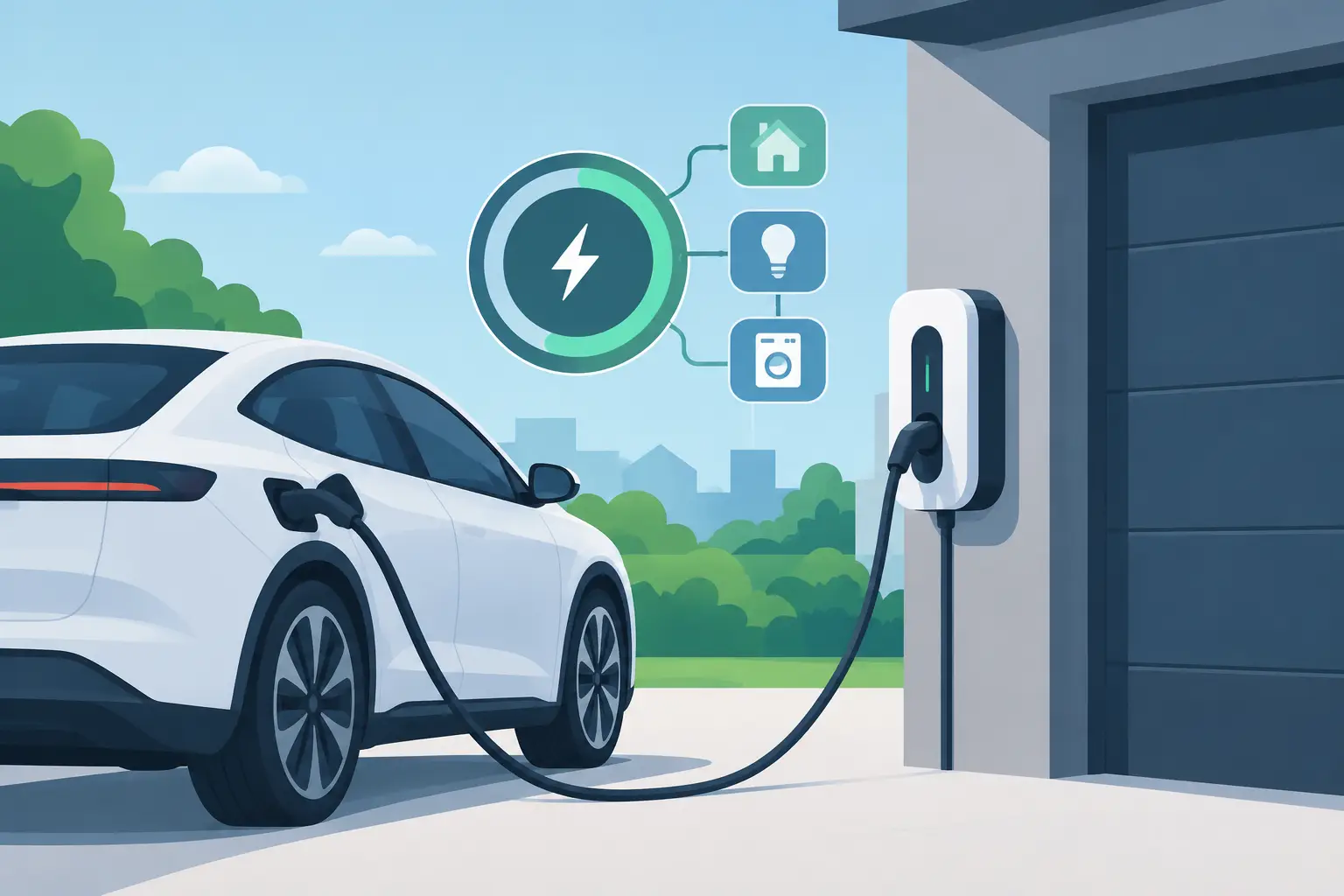
A Level 2 EV charger can add the equivalent of another major appliance to your home’s electrical demand, but the answer to how much electrical capacity does an EV charger reserve is not simply the number printed on the charger. It depends on the charger’s output, the circuit feeding it, your home’s existing electrical load, and the capacity of the service panel. A qualified electrician looks at all four before installing equipment.
For homeowners in Baltimore and across the Mid-Atlantic, this matters because many homes were built long before electric vehicles, central air systems, induction ranges, heat pumps, and other high-demand equipment became common. A charger may fit physically in the panel, yet the home may not have enough available electrical capacity to support it safely.
An EV Charger Reserves Capacity as a Continuous Load
The equipment mounted on the wall is technically called EV supply equipment, or EVSE. It delivers electricity to the vehicle over several hours, which electrical codes treat as a continuous load. A continuous load is expected to run for three hours or more.
Because of that rule, the charging load must be calculated at 125% of the charger’s maximum output. This safety margin prevents a circuit, breaker, and wiring from operating at their absolute limit for long periods.
For example, a 32-amp Level 2 charger needs a 40-amp dedicated circuit. The charger uses up to 32 amps while operating, but the home’s electrical system must reserve 40 amps of circuit capacity for it. A 40-amp charger needs a 50-amp circuit, and a 48-amp charger needs a 60-amp circuit.
That does not mean a 48-amp charger permanently pulls 60 amps from the utility. It means the branch circuit is sized to carry the charging load safely, with the required continuous-load allowance. The actual household demand changes throughout the day as equipment turns on and off.
Typical EV Charging Capacity Requirements
Most homeowners choosing Level 2 charging fall into a few common ranges. The right choice depends on the vehicle, daily driving distance, charging schedule, and what the house can support.
A basic Level 1 charger plugs into a standard household receptacle and typically draws 12 amps. It charges slowly, often adding only a few miles of driving range per hour. It can work well for low-mileage drivers, but it still needs a properly installed, dedicated circuit and a receptacle in good condition.
Level 2 charging is the more convenient option for many households. A 16-amp Level 2 charger requires a 20-amp circuit. A 24-amp unit requires a 30-amp circuit. A 32-amp unit requires a 40-amp circuit, while a 40-amp unit requires a 50-amp circuit. Higher-output 48-amp chargers need a 60-amp circuit and are commonly hardwired rather than plugged into an outlet.
Some vehicles and charging equipment can use even more power. An 80-amp charger, for instance, requires a 100-amp circuit. That is a significant portion of a typical 200-amp home service and calls for a careful load calculation. Faster is not always better if a lower-output charger will fully recharge the vehicle overnight without forcing expensive electrical upgrades.
Circuit Size Is Not the Same as Panel Capacity
A common misunderstanding is that an open breaker space means a charger can be added. Breaker spaces provide room for a new circuit. They do not prove the panel or service has enough capacity for another continuous load.
A 200-amp panel may contain breakers whose numbers add up to much more than 200 amps. That can be normal because not every appliance operates at full output at the same time. Still, adding an EV charger requires an electrician to calculate the home’s expected load under code rules, not just count breaker spaces.
The calculation considers the home’s square footage and general lighting load, as well as fixed appliances and major equipment. Electric ranges, dryers, water heaters, air conditioning, electric heat, well pumps, hot tubs, pool equipment, workshops, and a second EV can all affect the result. The largest heating or air-conditioning loads are particularly important.
How an Electrician Determines Available Capacity
An EV charger installation starts with more than selecting a charging speed. The electrician inspects the panel’s rating, the service size, available breaker space, grounding and bonding, wiring condition, and the route from the panel to the charging location.
Then comes a residential load calculation. This calculation applies code-approved demand factors rather than assuming every appliance runs at maximum power at once. It reveals whether the existing service can accommodate the proposed charger while keeping the home’s electrical system within safe limits.
In some homes, the calculation supports a 40-amp or 60-amp EV circuit without any panel work. In others, the panel may have adequate service capacity but no physical room for another breaker. A panel upgrade, subpanel, or approved breaker arrangement may solve that issue.
Older homes can present a different challenge. A 100-amp service may already be carrying central air conditioning, an electric dryer, a range, and other substantial loads. Adding a high-output charger could exceed the service calculation. In that situation, a service upgrade may be the safest long-term choice, especially if the homeowner expects to add a heat pump, electric water heater, or additional EV later.
Options When Your Home Is Near Its Electrical Limit
Not every home needs a full service upgrade before installing EV charging. A good installation plan should match the household’s actual needs instead of automatically choosing the largest charger available.
Choosing a lower-amperage charger is often the simplest option. A 24-amp or 32-amp Level 2 charger can still provide substantial overnight charging for many drivers. If the vehicle is parked for 10 to 12 hours, there may be no practical benefit to reserving 60 amps for a charger that will finish well before morning on a smaller circuit.
Load management equipment may also be an option where permitted and appropriate. These systems monitor the home’s demand and reduce or pause charging when other major loads are active. The charger resumes when capacity is available. This can help avoid overloads without compromising the operation of essential household equipment.
A subpanel can add circuit space, but it does not create more utility service capacity by itself. If the load calculation shows the main service is already near its limit, the solution may still be a service upgrade. That distinction is worth understanding before comparing installation quotes.
Why Dedicated Wiring and Permits Matter
An EV charger should be on a dedicated circuit sized for the equipment’s actual rating. It should not share a circuit with a dryer, garage outlets, lighting, or another appliance. The wire size, breaker type, receptacle or hardwired connection, and GFCI protection requirements must all match the applicable electrical code and the manufacturer’s instructions.
Permitting and inspection requirements vary by municipality and can change as local code editions are adopted. Professional installation helps ensure the work meets the rules in your area and gives you a reliable charging setup for daily use. It also helps identify concerns that may otherwise remain hidden, such as overheating connections, undersized conductors, corrosion, or an outdated panel.
Plan for the Home You Expect to Have
A charger installation is a good time to think beyond the vehicle you drive now. If a second EV, electric heat, a hot tub, solar equipment, or an induction range may be part of your plans, tell your electrician. Planning for those future loads can prevent repeated panel work and help you make a more cost-effective decision.
Stella Electric can evaluate your existing panel, perform the needed load calculation, and recommend a charging solution that fits your home and driving routine. The goal is not to reserve more electrical capacity than you need. It is to give you dependable charging with wiring and protection designed for safe, everyday use.
Before buying the highest-output charger on the shelf, schedule an electrical assessment. The right charger is the one that gets your vehicle ready when you need it while leaving your home’s electrical system operating safely and confidently.








